

Recently, I created a post on LinkedIn about how I have leveraged custom GPTs for work-life harmony. I believe it’s a game changer and thought it would be a good idea to share my experience of creating custom GPTs for both work and personal life. Imagine having a personal assistant who is an expert in each area of your life!
Artificial intelligence (AI) has been on a rapid evolutionary path, with major breakthroughs and advancements occurring at an unprecedented pace. One of the most significant developments in recent years has been the rise of large language models, particularly the Generative Pre-trained Transformer (GPT) technology by OpenAI. AI is not new. In fact, Google has been using AI in search for years. In 2018, Google introduced BERT (Bidirectional Encoder Representations from Transformers), the same transformers that you see in ChatGPT today. BERT enabled Google to read entire sentences rather than just keywords, making it capable of understanding complex queries, including longer voice searches. In 2021, Google introduced a more powerful model called MUM (Multitask Unified Model), which allowed Google to analyse different languages and provide even more sophisticated answers.
Here is an example of MUM in action: for a query like, “Last year my daughter climbed Mount Kilimanjaro and this year she is climbing Mount Fuji. What is the difference in the kit list from last year to this year?” Google has been able to provide comprehensive answers since 2021. However, many of us still rely on keyword searches and visit various sites to compare and find the best answer.
Search engines are now more capable than ever of understanding and responding to complex queries due to these advancements in AI technology, which are now manifesting alongside generative AI.
As the capabilities of these models expanded, so did the demand for customisation and personalisation. In January 2024, OpenAI launched the GPT Store, a revolutionary platform that allows businesses and individuals to create and deploy their own custom GPT models tailored to their specific needs and use cases.
The GPT Store introduced the concept of “custom instructions,” enabling users to fine-tune the behaviour and knowledge base of the GPT models. This opened up a world of possibilities, empowering organisations and individuals to leverage the power of AI in ways that were previously unimaginable.
Whether you’re a business looking to streamline operations, enhance customer experiences, or unlock new revenue streams, or an individual seeking to augment your personal productivity and creativity, custom GPTs offer a game-changing opportunity. By tailoring these models to your unique requirements, you can harness the power of AI to achieve your goals more efficiently and effectively.
As of early 2024, over 3 million custom GPTs have been created, highlighting the rapid adoption and diverse applications of this technology across various industries.
The Journey from Custom Instructions to Custom GPTs
When OpenAI first introduced custom instructions for their groundbreaking ChatGPT model, it unlocked new possibilities for personalising and fine-tuning the AI’s behaviour. Initially, these custom instructions were relatively simple prompts or guidelines that could steer the model’s responses in a desired direction.
For my industry (SEO), custom instructions found early use cases in areas like content strategy and SEO. For instance, this was my custom instructions when I was working for an SaaS Enterprise SEO platform:
“I am an SEO expert and work with global clients to help improve their online visibility. This often includes making technical as well as content recommendations. I also study Google’s algorithm updates and use data from the search landscape in every part of my work.
I want you to work as my SEO expert assistant and read my requests very carefully, ask questions where relevant to help you give the perfect answers. When working on SEO problems I will ask you to act as an SEO expert. When I use this at the start of a prompt you will do your best to impress me with a very detailed level of response. Don’t explain what you’re doing unless I ask you. Present your responses professionally and use clear structure with appropriate headings.”
This allowed me to leverage ChatGPT’s natural language processing capabilities while ensuring the output was tailored to their specific needs.
On a personal level, custom instructions enabled creative use cases as well. A busy parent could provide instructions such as:
“You are a virtual assistant responsible for managing my children’s activities and schedules. Your role is to help plan playdates, schedule extracurricular activities, and keep track of important dates and events related to my kids.”
While these initial custom instructions were powerful, they were ultimately limited by the confines of the original ChatGPT model’s training data and capabilities.
The launch of the GPT Store in January 2024 ushered in a new era of customisation – the ability to create and deploy entirely new custom GPT models from the ground up. These custom GPTs could be fine-tuned not only with specific instructions but also with proprietary data, domain knowledge, and desired behaviours.
The benefits of custom GPTs are numerous:
- Time Savings: Custom GPTs eliminate the need to repeatedly update instructions for different contexts. Once set up, these models understand your specific requirements and provide consistent, relevant outputs, saving significant time and effort.
- Unparalleled Personalisation: Organisations can now create AI models tailored to their specific industries, products, services, and processes, ensuring optimal performance and relevance.
- Data Privacy and Security: By training custom GPTs on proprietary data, businesses can maintain strict control over sensitive information while still leveraging the power of AI.
- Continuous Learning and Adaptation: Custom GPTs can be continually fine-tuned and updated as new data and requirements emerge, enabling a constantly evolving and improving AI solution.
Whether you’re a business seeking a competitive edge or an individual looking to unlock new levels of productivity and creativity, the journey from simple custom instructions to fully customised GPT models has opened up a world of possibilities.
How I use custom GPTs for work?
In my professional life, I leverage a variety of custom GPTs to enhance productivity and efficiency, ranging from keyword research to content analysis. Today, I’d like to highlight one particularly valuable tool: the Conversation Keyword Generator.
Conversation Keyword Generator
This custom GPT is designed to convert standard keywords into long-tail, natural language search terms. As search behaviour evolves, users are increasingly moving away from short, generic keywords to more specific, conversational queries. This shift necessitates a more nuanced approach to keyword research and optimisation.
Functionality and Benefits:
- Keyword Expansion: The Conversation Keyword Generator takes your initial keywords and expands them into detailed, long-tail phrases. For example, instead of simply targeting “SEO tips,” the GPT might generate phrases like “how to improve SEO rankings for a small business” or “best SEO practices for 2024.”
- Natural Language Processing: By focusing on natural language search terms, this GPT aligns more closely with the way users phrase their queries, leading to better alignment with user intent and improved search performance.
- Performance Tracking: These long-tail keywords can then be tracked to monitor their performance over time, providing insights into how effectively they capture search traffic and convert visitors.
Implementation and Impact
Using this custom GPT, I can quickly generate a comprehensive list of long-tail keywords that are more likely to match the specific questions and needs of my audience. This not only enhances our SEO strategy but also ensures that our content remains relevant and accessible. The ability to track these keywords and monitor their performance allows for continuous optimisation, helping us stay ahead of trends and adjust our strategies as user behaviour evolves.
Incorporating the Conversation Keyword Generator into my workflow has streamlined the keyword research process, saving time and improving the effectiveness of our content marketing efforts. By focusing on more specific, conversational search terms, we can better meet the needs of our audience and improve our overall search engine rankings.

Leveraging Custom GPTs in the E-commerce Industry
The e-commerce industry is a highly competitive and dynamic landscape, where businesses constantly strive to optimise their online presence, improve customer experiences, and drive sales. One critical aspect of e-commerce success is efficient content management, particularly for product listings and descriptions.
With thousands, or even millions, of products to showcase, creating compelling, search engine-optimised content for each listing can be a daunting and time-consuming task. Imagine writing a product description for a lipstick. Now think about how many colours they have and how many pieces of content you have to write about. Think about a cashmere jumper—how many ways can you make the content fresh for a cashmere jumper? This is where custom GPTs have emerged as game-changers, enabling e-commerce businesses to streamline their content creation processes while delivering high-quality, tailored product descriptions at scale.
Case Study: Creating Custom GPTs for Product Listing Pages (PLPs) and Product Description Pages (PDPs)
I recently created two custom GPTs for a leading online retailer to help them streamline their content management strategy: one for generating optimised product listings (PLPs) and another for crafting detailed product descriptions (PDPs).
Custom GPT for Product Listing Pages (PLPs)
The PLP custom GPT was trained on a vast dataset of existing product listings, combined with the customer’s proprietary data on product specifications, pricing and sales trends. Additionally, the model was fine-tuned with specific instructions and guidelines to ensure the generated listings adhered to the customer’s branding and tone of voice.
By leveraging this custom GPT, the customer was able to streamline the creation of new product listings, saving countless hours of manual effort. The AI-generated listings were not only consistent and on-brand but also optimised for search engines, incorporating relevant keywords and structured data markup. These listings still had a layer of human oversight to add a personal touch, saving significant time and effort.
Custom GPT for Product Description Pages (PDPs)
For detailed product descriptions, we created a separate custom GPT model, trained on a comprehensive corpus of product information, technical specifications, and existing high-performing descriptions. This model was specifically designed to generate in-depth, engaging, and informative descriptions that would captivate potential customers and drive conversions.
The PDP custom GPT allowed the customer to quickly generate compelling descriptions for new products, ensuring that they were not only SEO-friendly but also accurately highlighted key features, benefits, and unique selling points. By implementing these custom GPTs, the customer experienced a significant boost in their content creation efficiency.
As the e-commerce landscape continues to evolve, custom GPTs are poised to become indispensable tools for businesses seeking to stay ahead of the competition and deliver exceptional customer experiences through optimised, engaging, and tailored product content.
Best Practice for creating custom GPTs
Creating custom GPTs take Prompt Engineering to the next level. The beauty with Open AI’s Custom GPTs is that you can constantly refine your GPT and upload supporting documents such as brand’s tone of voice, customer personas and demographics and competitor information to train your personal AI Assistant. Start by telling the GPT exactly what you want and need.
Once you are happy with it then, save the GPT and try it.
Then Refine, refine and refine. You will never get a GPT right at the first go. If you do, then you are missing something. You can always improve your GPT.
How I use Custom GPTs for Personal Life Management
Balancing a demanding career with parenting two active children, without family support, has been one of my most challenging yet rewarding experiences. I’ve turned to Generative AI to create a sustainable system that not only aids my professional life but also enriches my family time. Here’s how I’ve integrated custom GPT models into our daily routine:
Homework Buddy
To effectively manage my children’s academic life, I’ve customised a GPT model that assists with planning revision schedules, assessing project work, and prepping for exams. This tool has proven to be a true game-changer in efficiently navigating their educational needs, ensuring they stay on top of their schoolwork and perform well academically.
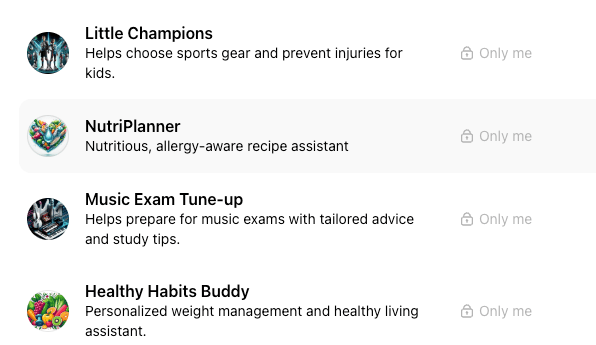
Music Exam Tune-up GPT
My children’s musical pursuits range from the cello to the organ, viola, piano, and oboe. This tailored GPT not only helps with preparing for music exams but also keeps track of upcoming concerts, workshops, and recitals, ensuring we never miss an important event and are always prepared. It provides practice schedules, exam tips, and tracks their progress, making music practice more structured and effective.
NutriPlanner
Managing different dietary needs, including various allergies, can be daunting. My GPT model suggests nutritious, allergy-aware recipes, streamlining meal preparation without compromising on health. It helps plan balanced meals that cater to each family member’s dietary restrictions, making meal planning less stressful and more enjoyable.
Little Champions
From karate to cricket, football, hockey, and netball, my kids enjoy a variety of sports. This GPT assists in selecting the appropriate gear and offers tips to prevent injuries, ensuring they’re equipped and safe. It keeps track of their training schedules, competition dates, and provides reminders for practices and matches, helping us stay organised and prepared.

The Importance of Specialised Custom GPTs
Mastering the art of prompt engineering is crucial for harnessing the full potential of AI. Building your own custom GPTs can streamline this process even further. We all use ChatGPT for various purposes, from work-related tasks to personal assistance. Instead of continuously adjusting prompts to fit different roles—say, switching from being an SEO expert to a parent—I advocate for developing specialised GPTs. These tailored AI assistants are designed to seamlessly integrate into specific aspects of your life, thus simplifying interactions and saving precious time—time that I prefer to spend with my family.
Conclusion
The advent of custom GPTs has ushered in a new era of personalised artificial intelligence, transforming how we live, work, and interact with technology. These tailored AI models offer unparalleled opportunities for both business and personal applications, making them invaluable assets in various contexts.
For businesses, custom GPTs have proven to be game-changers. They drive efficiency, accuracy, and scalability across a wide range of industries by automating repetitive tasks, generating tailored content, and providing instant, personalised support. From enhancing customer service to streamlining content creation in e-commerce, the benefits of custom GPTs are significant and far-reaching. Companies using these AI models report substantial improvements in customer satisfaction, productivity, and revenue growth, underscoring their transformative potential.
On a personal level, custom GPTs offer a path to regaining control and finding balance in our increasingly hectic lives. They can manage family schedules, assist with children’s academic and extracurricular activities, streamline meal planning, and even provide personalised financial advice. By integrating these AI assistants into daily routines, individuals can enhance their productivity, organisation, and overall quality of life. The ability to tailor GPTs to specific personal needs ensures that each model is perfectly suited to the unique challenges and preferences of the user.
As we look to the future, the potential of custom GPTs continues to evolve and expand. With ongoing advancements in AI technology and the increasing availability of data, these models will become even more sophisticated, capable of tackling complex tasks and seamlessly integrating into our daily routines. Whether assisting with mundane tasks or serving as creative collaborators, custom GPTs will play a crucial role in shaping the future of personalised AI.
If you haven’t already, I encourage you to explore the GPT Store and embark on your journey of creating a custom GPT. Whether you’re a business owner, entrepreneur, or an individual seeking to optimise your personal life, this platform offers the tools and resources to bring your vision to life.
The age of personalised AI is here, and custom GPTs are at the forefront of this revolution. Embrace the opportunity to harness the power of these tailored models and unlock new levels of efficiency, creativity, and personal fulfilment. The future belongs to those who dare to dream and innovate, and custom GPTs are the key to turning those dreams into reality.

 Connect the AI Dots